
OSHA Hazard Communication Standard: 2024 Update and Compliance Guide
Originally published to cover OSHA’s 2021 proposed rule. Updated to reflect OSHA’s 2024 final rule and upcoming deadlines.
OSHA's updated Hazard Communication Standard (HCS) took effect on July 19, 2024, after the agency published the final rule on May 20, 2024. The updated OSHA hazard communication standard aligns U.S. chemical safety requirements with the seventh revision of the United Nations' Globally Harmonized System of Classification and Labelling of Chemicals (GHS), along with select elements of Revision 8. This is the first major revision to the HCS since OSHA adopted GHS Revision 3 in 2012, and it touches hazard classification, container labeling, safety data sheets (SDSs), and trade secret provisions. The rule is in effect, and OSHA uses phased compliance deadlines, making this a priority for any organization that manufactures, imports, distributes, or uses hazardous chemicals.
Who Is Affected
The 2024 Hazard Communication Standard applies to chemical manufacturers, importers, distributors, and employers that use hazardous chemicals. Chemical manufacturers and importers must reclassify affected substances and mixtures and update SDSs and labels by the applicable deadlines. Distributors are subject to the phased compliance dates for their applicable obligations under the rule.
Employers at any facility where workers handle, store, or may be exposed to hazardous chemicals are also covered. This includes downstream workplaces where employees may be exposed to hazardous chemicals, subject to applicable OSHA HCS coverage and exemptions. Hazard communication violations are consistently among OSHA's most frequently cited standards, which means enforcement attention on HazCom programs is already high heading into these new deadlines. If your organization maintains a written HazCom program and SDS library under 29 CFR 1910.1200, the 2024 final rule applies to you. Even employers who do not manufacture or distribute chemicals will need to update their programs and training once suppliers begin providing revised labels and SDSs under the new standard.
What Changed in the 2024 HazCom Final Rule
The 2024 HazCom final rule revises hazard classification criteria, container labeling requirements, and safety data sheet provisions under 29 CFR 1910.1200. These changes apply to both new and existing hazardous chemicals throughout the supply chain. Below is a summary of the most significant updates, grouped by category.
Hazard Classification Updates
Under the revised standard, OSHA expands the aerosols hazard class to include non-flammable aerosols (Category 3) and clarifies aerosol classification criteria and labeling elements. Categories 1 and 2 continue to cover flammable aerosols. Flammable aerosols remain classified within the aerosols hazard class and are not additionally classified as gases under pressure or chemicals under pressure.
Desensitized explosives are now recognized as a separate physical hazard class with four categories. These are chemicals that have been treated to suppress or reduce their explosive properties but still present physical hazards during normal use or storage. Previously, these chemicals were classified alongside other explosives without distinct labeling for the stabilization-related hazards they pose.
Pyrophoric gases are reclassified as Category 1A flammable gases. When OSHA first aligned the HCS with GHS Revision 3 in 2012, the GHS did not yet address pyrophoric gas classification. The 2024 rule adopts the classification criteria established in GHS Revision 7, which categorizes pyrophoric gases alongside chemically unstable gases under the flammable gas framework. The final rule also addresses chemicals under pressure and relocates the definition of combustible dust to the standard's definitions section for clarity.
Labeling Updates
The final rule codifies labeling accommodations for small containers. Containers holding 100 mL or less may use reduced label elements, and containers at or below 3 mL have additional accommodations based on OSHA's existing enforcement guidance. These provisions address a longstanding gap in the standard where small packaging lacked practical labeling options.
OSHA also clarified labeling requirements for bulk shipments, defining a bulk shipment as any hazardous chemical transported in a container that doubles as the mode of transportation (such as a tanker truck or railcar). A separate provision relieves chemical manufacturers from the obligation to relabel containers that have already been released for shipment when new hazard information becomes available. Manufacturers must still include an updated label with the shipment itself, but containers already packaged and palletized in warehouses do not need to be physically relabeled.
Safety Data Sheet Updates
Trade secret protections under the HCS have been expanded. Manufacturers may now withhold concentration ranges for ingredients classified as trade secrets, selecting from a prescribed list of allowable ranges. This change brings U.S. requirements closer to Canada's Hazardous Products Regulations (HPR) and gives manufacturers more flexibility while still communicating meaningful hazard information to workers and first responders.
SDS Section 9 now requires the inclusion of particle characteristics for applicable substances. Section 1 of each SDS must include a U.S. domestic address and phone number. OSHA also revised precautionary statements to align with GHS Revision 7 and added a provision allowing minor textual variations in precautionary statements to reduce redundancy on labels, particularly for products classified under multiple hazard categories.
Compliance Deadlines
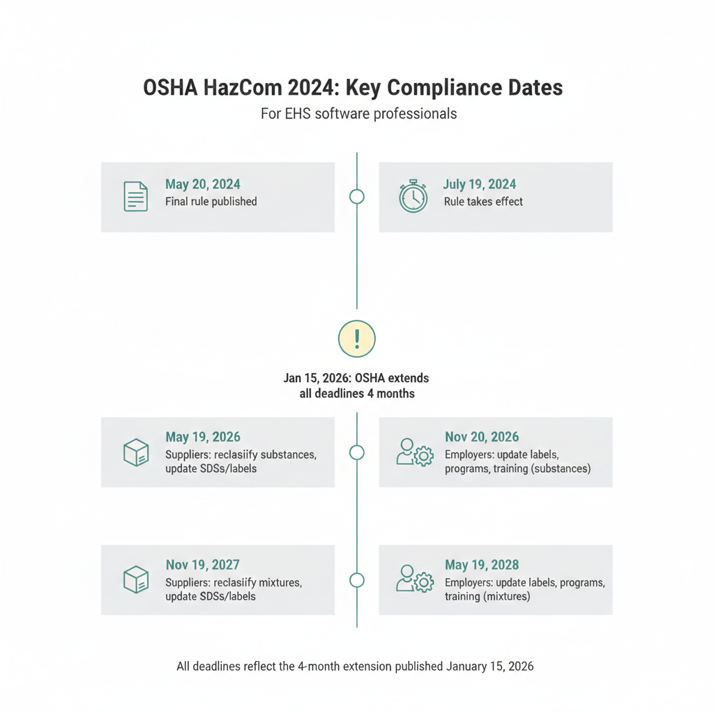
OSHA extended all HazCom compliance deadlines by four months on January 15, 2026, shifting the first deadline for substance evaluations to May 19, 2026. The agency published the extension to give the regulated community additional time to review agency guidance before the first deadline took effect. The extended deadlines are:
- Chemical manufacturers, importers, and distributors evaluating substances: May 19, 2026
- Employers handling substances (workplace labels, HazCom program updates, employee training): November 20, 2026
- Chemical manufacturers, importers, and distributors evaluating mixtures: November 19, 2027
- Employers handling mixtures: May 19, 2028
During the transition period, organizations may comply with the 2012 version of the HCS, the 2024 updated standard, or a combination of both, until their applicable compliance deadline arrives. This flexibility allows manufacturers to begin shipping products with updated labels and SDSs before the full deadline, without requiring downstream employers to update their programs until the employer-specific dates. Once a deadline passes, compliance with the 2024 standard becomes mandatory for that party.
What Employers Should Do Now
Even if your organization is not a chemical manufacturer, the 2024 HazCom updates will affect your workplace as suppliers begin sending revised SDSs and relabeled products. Taking steps now avoids a last-minute compliance scramble as employer deadlines approach. The actions below apply to employers at facilities where workers use or may be exposed to hazardous chemicals.
- Review your chemical inventory at each work site. Identify which products fall under the substance deadline (May 2026 for suppliers, November 2026 for employers) versus the mixture deadline (November 2027 for suppliers, May 2028 for employers). This distinction determines your compliance timeline and helps prioritize which updates need attention first.
- Contact your chemical suppliers to confirm their plans for providing updated SDSs and container labels. Your ability to update workplace labeling, your written HazCom program, and employee training depends on receiving that updated information from upstream in the supply chain.
- Update your SDS library and ensure workers have immediate access to the new versions.
- Update your written HazCom program to reflect the revised standard's requirements for any new hazard classes, labeling changes, or SDS formatting that apply to the chemicals at your facility.
- Plan employee training around the specific changes that affect your workforce. Employees will need to recognize new label elements for hazard classes that did not previously exist under the 2012 standard (such as desensitized explosives and non-flammable aerosols). OSHA requires employers to provide HazCom training whenever new chemical hazards are introduced into the workplace or when the standard's requirements change, per 29 CFR 1910.1200(h).
For the full regulatory text, compliance resources, and OSHA's redline strikeout document showing all changes from the 2012 standard, visit OSHA's HazCom rulemaking page. With the first supplier deadline arriving in May 2026 and employer deadlines following close behind, now is the time to confirm your compliance strategy and begin updating your HazCom program. Organizations that act early will have a smoother transition as updated hazard information flows through the supply chain.


 7 Principles of Psychology ...
Latest Posts
- Corrective Action Management: From Open Item to Verified Fix
- OSHA Recordkeeping for Multiple Locations | Multi-Site Guide
- Reducing Human Error in the Workplace: Strategies, Tools, and Safety Leadership
- OSHA Form 301: Requirements, Completion Guide, and Best Practices
- 5 Best Practices for Creating a Storyboard & Shot Sheet to Develop an eLearning Course
Topics
See all
- Safety Training
- Safety Resources
- News and Regulatory Alerts
- EHS Software
- Case Studies
- Violations and Penalties
- What is OSHA
- Health and Safety
- COVID-19 Corona Virus
- Conferences
- Near Misses
- OSHA Top 10 Cited Standards
- Workforce Safety
- Driver Safety
- Slips, Trips and Falls
- Whistle Blower Protection
- Experience Modification Rate
- Featured
- Hazard Communication
- Joint Employment
- Recordkeeping and Reporting
- Workers Comp
- Arc Flash
- Chemical Safety
- E-Learning
- Electrical Safety
- Foreign Languages
- How to Increase the EHS Budget
- Human Error
- Lockout / Tagout
- Mobile Apps
- OSHA 301
- OSHA Inspections
- OSHA Severe Injury Reporting Program
- OSHA Violations
- Parking Lot
- Repeat Offender Penalties
- SOC 2 Compliance
- Safety Meetings
- Salary Surverys
- Stop Work Authority
- Winter Safety
- Workers' Compensation
- audit and Inspections
- E-Learning
- Educational Strategies
- Featured
- Self Directed Learning
- Blended Learning
- Social Learning
- eLearning Storyboard
